Write At Home 2
During the schools closure, in addition to my daily storytime on weekdays (2.30pm, Instagram Live), I’m also going to be creating and sharing some creative writing resources and tips for your children learning and playing at home.
Here is the first very simple one. Enjoy!
It’s wonderful that so many of you want to continue reading my books out to your class online during the school closure. Normally this is more complicated than it sounds due to copyright issues (my publisher holds the audio book rights) but owing to the exceptional circumstances we find ourselves in, Hachette Children’s Group have generously granted an open license to September 30th, and you can find the details below.
All of my titles are available as audiobooks on Audible.
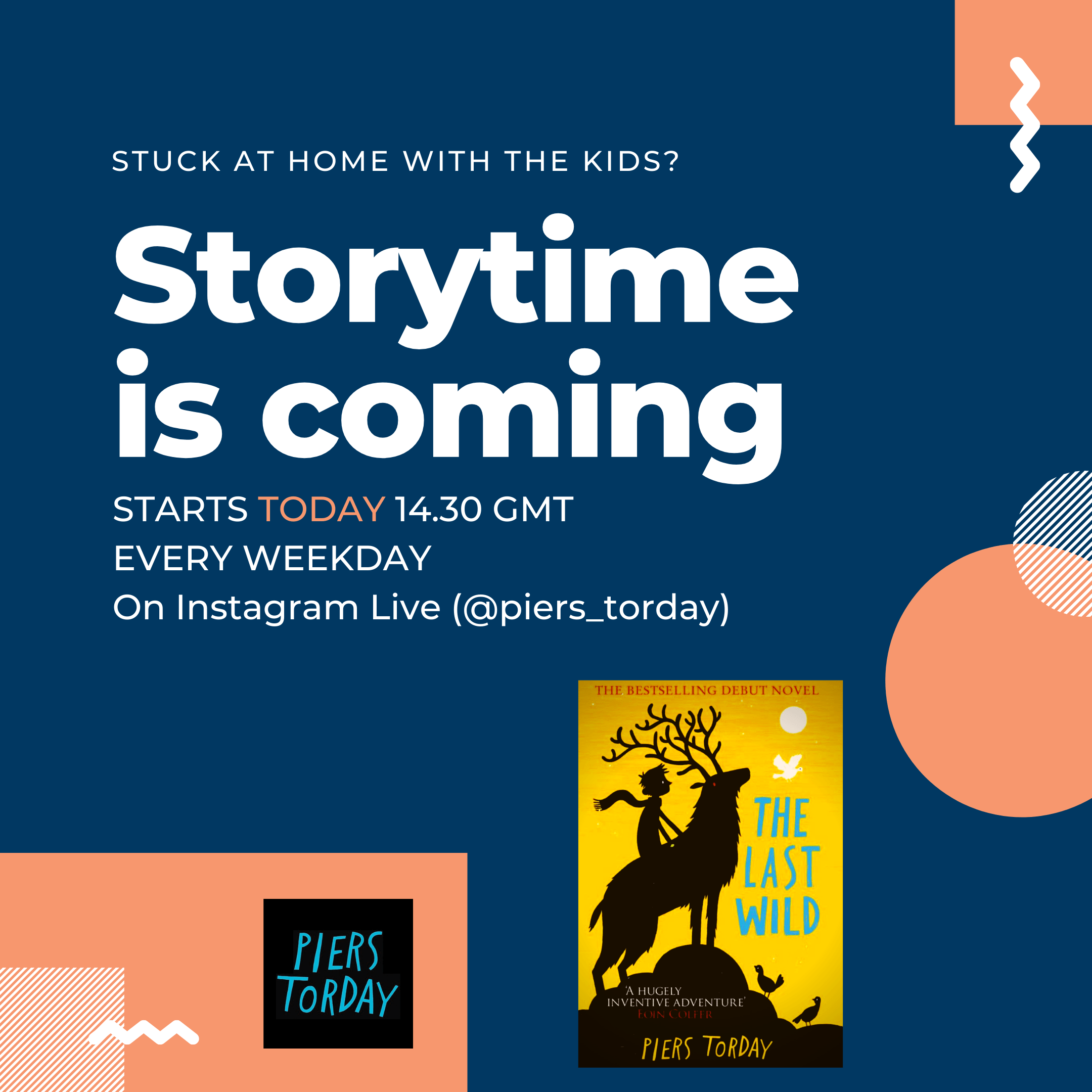
And I will also be reading all of my titles out loud, daily on weekdays, at 2.30pm every day, on Instagram Live (@piers_torday), a chapter a day, beginning with The Last Wild. The chapters will be available on Instagram TV for 24 hours.
Happy Reading and Listening! #unitedinbooks
Hachette Children’s Group: Open Licences and Permissions for Online Story-Time and Classroom Read-Aloud Videos and Live Events – information
In order to encourage reading and classroom read-aloud experiences, and to support schools, bookshops and public libraries forced to close by the COVID-19 situation, Hachette Children’s Group is permitting authors, illustrators, teachers, librarians and booksellers to create and share story-time and read-aloud videos and live events on closed educational platforms or streamed temporarily on a live platform.
GUIDELINES FOR EVERYONE
Teachers, librarians, booksellers, authors and illustrators providing content for children during the period 19th March to 30th September 2020:
Financial gain
For clarity, permission is granted only for free use of the readings. If you are planning to charge for any use of these recordings, you should contact HCG.editorial@hachettechildrens.co.uk in the first instance, seeking formal agreement, which may not be granted.
Guidelines for educational settings
Guidelines for public libraries and bookshops
For authors, illustrators, booksellers and librarians who wish to provide a story-time reading or other read-aloud experience to young people who would otherwise visit the library or bookshop in person:
Our guidance on the percentage of content to be recorded for hosting on open platforms, is usually to follow standard permissions practice, specifically designed to protect IP. However, we acknowledge that we are not operating in normal circumstances, so are happy to allow authors or illustrators, who wish to do so, to host recorded content of themselves reading their book/s on open platforms, until the 30th September.
If you are sharing your content with a third party platform, please do let us know so we can support this activity online and please do make a note to ensure the content is taken down by 30th September. Of course, no one knows how long the current situation is going to go on for, so it may be that we decide to extend this date and we will of course let you know.
I hope everyone is keeping safe at this challenging time for us all.
Sadly all my school and public events are either cancelled or postponed, check back for details in due course.
If you want to stay entertained during the outbreak, many independent booksellers and so far most branches of Waterstones remain open, and are scaling up their delivery services.
All my titles are available as e-books from the usual online retailers, links on my book pages.
All my titles are available as audio books from Audible, links on my book pages.
I will shortly be sharing classroom resources for all my books, from this website.
And soon, I will be doing readings of my books on Facebook and Instagram, as well as creative writing tutorials to help with the home schooling, check my social media channels for details.
Stay well!
Piers
When Charles Dickens published his ‘little Christmas book’ in 1843, it took just six weeks for the first adaptation to reach the stage. It played in London for more than forty nights before transferring to New York. In the year of publication alone, there were nine separate theatrical adaptations, including the first-ever musical version. Dickens himself was famous for his own public readings of the story, giving over 127 such recitals in England and America. And the process of retelling has continued for 176 years. From stage to screen, cartoon to musical, from the RSC to the Muppets, there are nearly thirty published adaptations of A Christmas Carol, and dozens more are written every Christmas. There was even a mime version by Marcel Marceau in 1973.
So why another? Well, whilst the tale has been retold for puppets and toys, and Scrooge performed by men young and old, the central role has remained resolutely masculine. What happens when we re-examine this classic fairy tale from a woman’s perspective, and reimagine the complex central character? And why?
The book is, at heart, a story about injustice. Dickens was horrified by the desperate destitution, especially in children, that he witnessed on his many legendary walks through industrial London. He initially drafted a political pamphlet in reply to an 1843 parliamentary report on working-class child poverty. But the Carol made his point more plangently.
Christmas Carol: A Fairy Tale | Want (Chisara Agor), Meagre (Yana Penrose), Ignorance (Joseph Hardy) | Wilton’s Music Hall, 2019 (photo by Nobby Clark)
Yet he was also no saint. It is perhaps telling that Catherine, his long-suffering wife (who was also a writer), titled her sole publication What Shall We Have for Dinner? She endured twelve pregnancies, bearing him ten children. These took their toll on her body, about which Dickens was privately offensive, and on her mind. Catherine was afflicted by what appears to have been severe post-natal depression, and Dickens responded by first taking up with a young actress, Ellen Ternan, then trying to persuade a doctor that his wife was insane, and should be put away in an asylum so he could continue his philandering unhindered.
Charles Dickens’s daughter Katey said that her father never understood women, and some of his excessively sentimentalised young female characters, like Little Nell in the Old Curiosity Shop, or the long parade of unattractive or damaged older women, such as Miss Havisham in Great Expectations, do not offer a very compelling counterargument to this analysis. But he was also a product of his age, a time of unstinting male power that frequently marginalised the voices of the poor, the indebted, the weak, the vulnerable – and women of all classes.
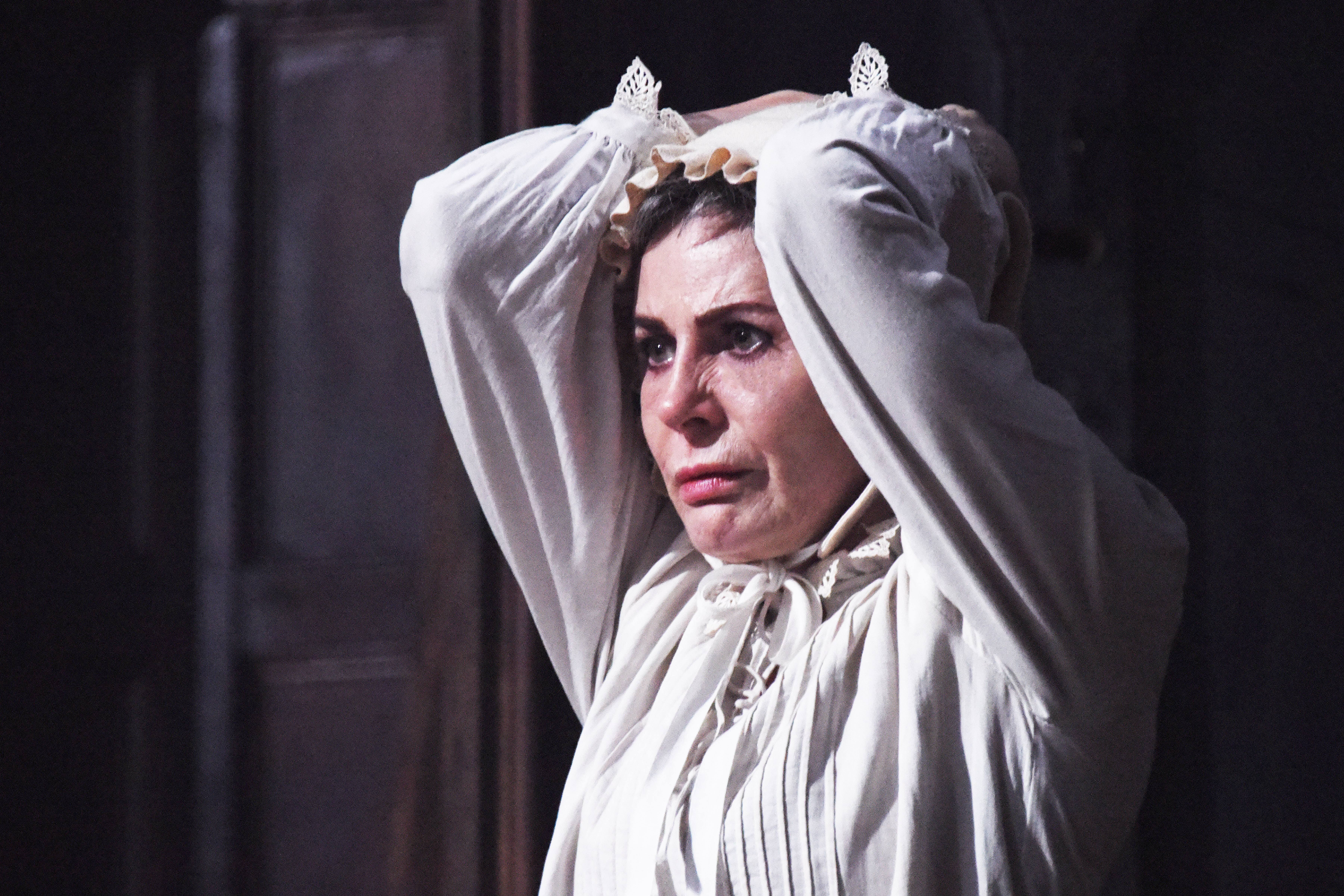
Christmas Carol: A Fairy Tale | Sally Dexter as Scrooge | Wilton’s Music Hall, 2019 (photo by Nobby Clark)
Christmas Carol is set in an intensely patriarchal society. The most powerful member of it, Queen Victoria, may have been a woman, but she also thought her own sex ‘poor and feeble’, and called for suffragists to be whipped. Her female subjects were expected to put ‘home and hearth’ before all else (often including any education and professional advancement). When she married, the rights of a woman were legally given to her husband. He took control of her property, earnings and money. If he wished to spend her money on his business or his debts, he did not require her consent. In exchange for this, she took his name. And until the 1857 Matrimonial Causes Act, divorce allowing remarriage was only possible by the passage of a private act through the Houses of Parliament.
Early nineteenth-century daughters, like the Fan Scrooge that Dickens imagines, were meant to get in line behind their brothers, like Ebenezer. In Dickens’s version, Fan dies early, leaving Ebenezer distraught.
But what if it had been the other way around? What if Fan Scrooge had tried to make her way in a man’s world of power and profit? What would have happened to Fan then?
Dickens wrote this enduring and uplifting story to try to heal the divisions of his own age. He yearned to create ‘a better common understanding among those whose interests are identical and who depend upon each other’. He wanted, in other words, to bring all people together, at a precious time of year, united in a love of the common good. And so do we. Merry Christmas, and God bless us, every one.
Christmas Carol: A Fairy Tale | Want (Chisara Agor), Ignorance (Joseph Hardy) and the Fezziwigs (Yana Penrose & Edward Harrison) | Wilton’s Music Hall, 2019 (photo by Nobby Clark)
To celebrate the forthcoming Wilton’s Music Hall production of my new play Christmas Carol – a fairy tale they are running a drawing competition for Key Stage 2 (Years 3 – 6). We would like you to draw or paint a picture of what you imagine one of the ghosts look like who visit Scrooge on Christmas Eve.
The winning entry will be printed on the front cover of the Christmas Carol – a fairy tale programme for the duration of the production’s run at Wilton’s, 29th November – 4th January.
The winner will also receive four tickets to see a performance of their choice of Christmas Carol – a fairy tale, subject to availability.
WHAT YOU NEED TO DO
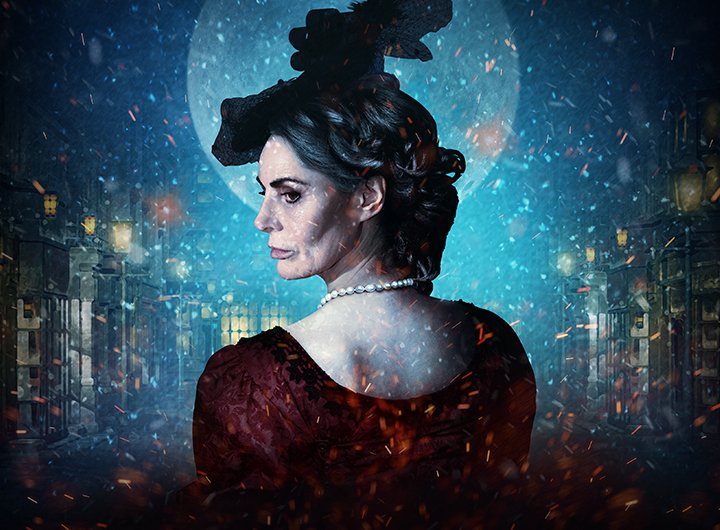
I’m delighted to announce that the role of the first ever female Scrooge on the London stage in my forthcoming retelling of Charles Dickens’ Christmas Carol will be the award winning star of stage and screen, Sally Dexter.
Sally is known for her appearances in some of our most loved West End productions, including Oliver! and Billy Elliot The Musical. She won an Olivier Award for her performance in Dalliance at the National Theatre and currently plays Faith Dingle in Emmerdale.
She will be joined by Chisara Agor (The Wizard of Oz at Birmingham Rep),Joseph Hardy (The Cherry Orchard at Bristol Old Vic and Manchester Royal Exchange) and Edward Harrison (Wolf Hall, Broadway).
Completing the cast are Brendan Hooper (The Importance of Being Earnest at the Vaudeville Theatre), Ruth Ollman (Still Alice, UK tour) and Yana Penrose (How Love is Spelt at Southwark Playhouse).
The show is designed by Tom Piper and directed by Stephanie Street.
Come and join in the magic as spellbinding magic, haunting music, and petrifying puppets are brought to life on the unique stage of Wilton’s Music Hall.
Paul Torday published his first novel Salmon Fishing in the Yemen aged 60. The family have decided to set up this new prize in Torday’s honour, celebrating first novels by authors aged 60 or over.
The winner will receive £1,000, with a set of Paul Torday’s collected works. Runners-up will receive one specially selected Paul Torday novel with a commemorative book plate.
Entry to the 2020 prize is now open.
The deadline for entries is 30 November 2019 at 5pm (GMT).
Important Information
God bless us all! My adaptation of Charles Dickens’s A Christmas Carol is coming to Wilton’s Music Hall in London this festive season…
1838, London. Jacob Marley is dead. And so is Ebenezer Scrooge…
In our story, Ebenezer died young, but his sister Fan married Marley and, as his widow, has now inherited his moneylending business.
She rapidly becomes notorious as the most monstrous miser ever known, a legendary misanthrope, lonely, and despised by all who cross her path.
Seven years later, on Christmas Eve, Fan Scrooge will be haunted by three spirits.
They want her to change. But will she?
This Christmas, rediscover a classic British fairy tale. Refreshed and relevant for the 21st century, this traditional story inspired by the politics of nineteenth century London comes to life in the true Dickensian atmosphere of the world’s oldest surviving music hall, Wilton’s Music Hall.
Brought to you by the team that gave you the sellout The Box of Delights, expect spellbinding magic, haunting music, and petrifying puppets in this triumphant retelling.
The first ever female Scrooge on the English stage.
Things are going to be different. Very different…
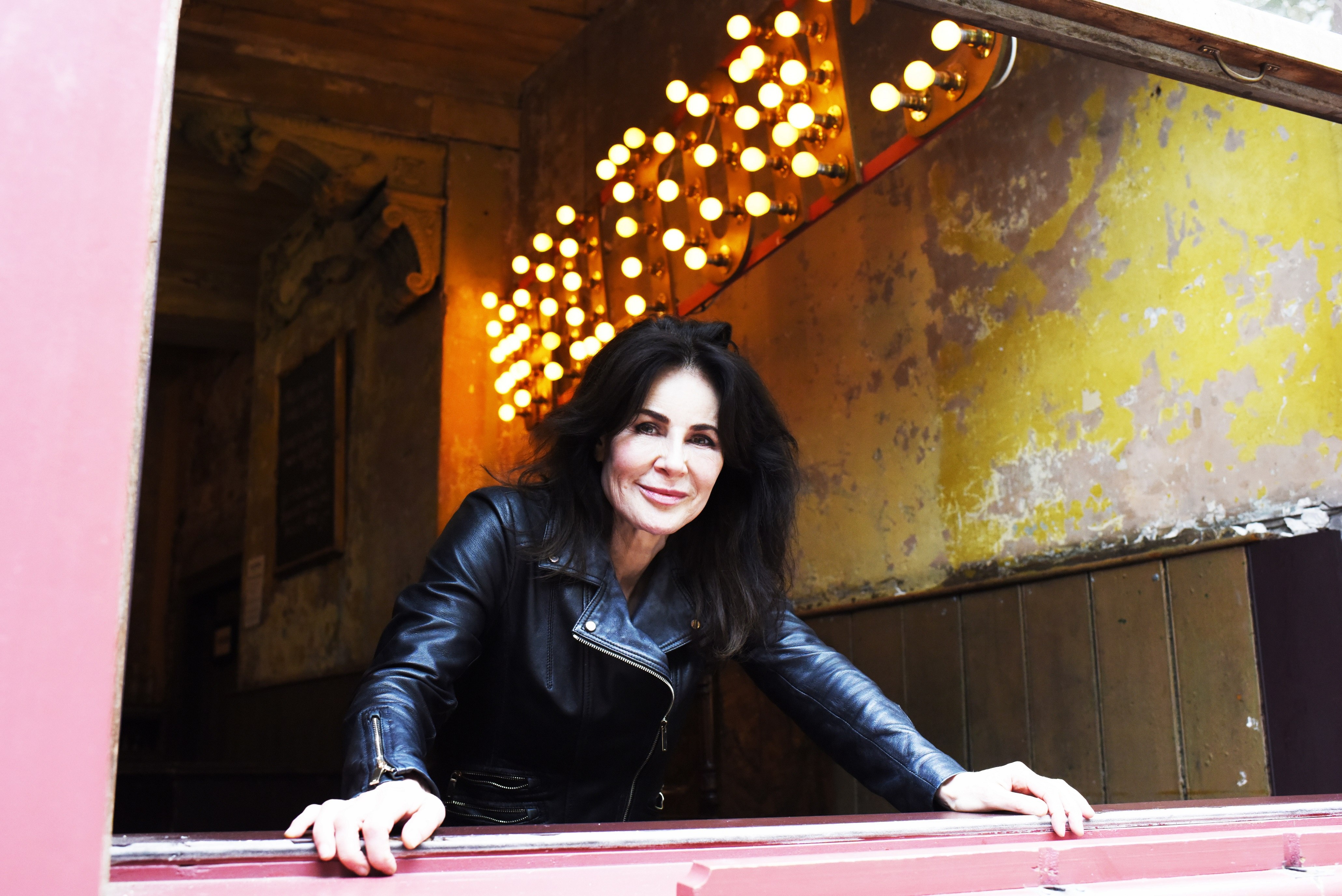
Stephanie Street is a writer, director and performer. Her most recent acting credits include James Graham’s Quiz, Chichester Festival Theatre and West End, and critically acclaimed performances at the National Theatre in Behind the Beautiful Forevers and Nightwatchman.
Age recommendation: 7+
Creative Team
Writer – Piers Torday
Director – Stephanie Street
Designer – Tom Piper
Lighting Designer – Katharine Williams
Composer and Sound Designer – Ed Lewis
Puppetry Designer – Jo Lakin
Casting Director – Gabrielle Dawes
Catch my video of writing tips below, or download their FREE Last Wild creative writing resource for use with your young people – discover where writing can take you!